
Local SEO for Plumbers: Show Up When It Matters Most
Learn how local SEO for plumbers works — from Google Maps rankings to your website — and what it takes to get more calls from people who need you right now.
Sean Patrick
4/9/20266 min read


A burst pipe doesn't wait. Neither does the person Googling "emergency plumber near me" at 11pm.
If your business isn't showing up in those first few results — the map pack, the top of the page — that call is going to someone else. And it's going to keep going to someone else until you fix the underlying problem.
That's what local SEO does for plumbing businesses. It puts you in front of people at the exact moment they need you. Here's how it works and what it actually takes to rank.
Why Local SEO Matters More for Plumbers Than Almost Any Other Trade
Plumbing is one of the highest-intent local searches that exists. When someone types "plumber in [city]" into Google, they're not browsing. They need help now — or they're about to.
That urgency means conversion rates from local search are exceptionally high compared to most industries. The person searching is already sold on needing a plumber. The only question is which one they call.
The businesses that show up at the top of Google Maps and the organic results get the lion's share of those calls. The ones buried on page two might as well not exist.
The Two Places You Need to Show Up
Local SEO for plumbers comes down to two real estate spots on Google:
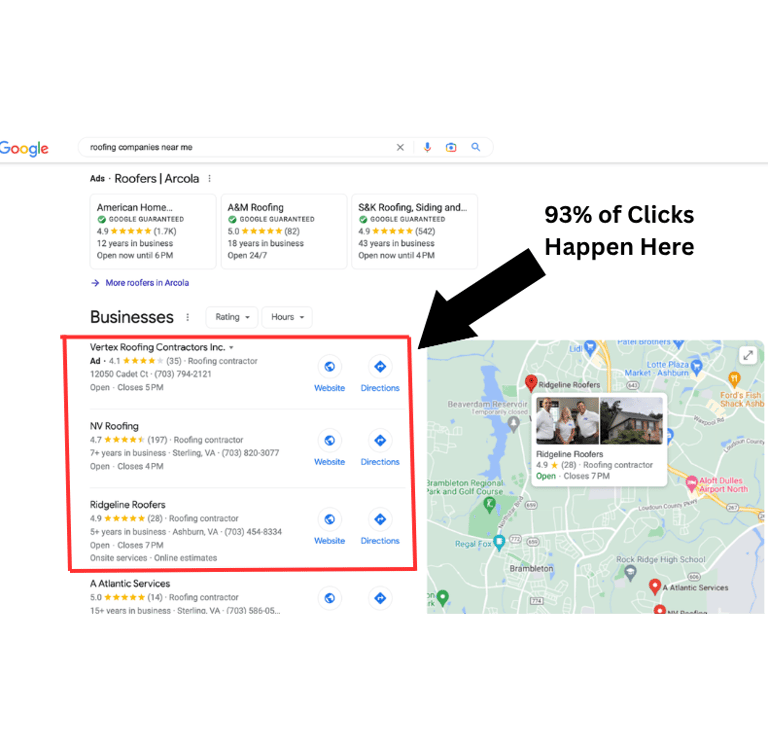
1. The Google Maps 3-Pack
This is the block of three business listings that appears near the top of the search results — usually above the regular website links. It includes your business name, rating, address, phone number, and a link to your Google Business Profile.
This is prime territory. Most people click here first. Getting into the 3-pack for searches like "plumber St. Helens" or "plumber Columbia County" is one of the highest-ROI things you can do for your business.
2. Organic Search Results
Below the map pack, you have traditional website listings. Ranking here takes longer and requires a solid, optimized website — but it compounds over time and covers searches the map pack doesn't always catch (longer questions, research-phase searches, specific service terms).
Ideally, you want both. A business that owns spots in the map pack and the organic results dominates the page and builds real trust with potential customers.
What Google Uses to Rank Local Plumbers
Google's local ranking algorithm weighs three main factors:
Relevance — Does your business match what the person searched for? This is where your website content and Google Business Profile (GBP) come in. If someone searches "water heater repair" and your GBP and website never mention water heater repair, Google can't confidently show you.
Distance — How close is your business to the searcher? You can't change your address, but you can make sure Google has accurate location data and that your service area is clearly defined.
Prominence — How well-known and trusted is your business? This factors in Google reviews, links to your website, mentions across the web, and the overall strength of your online presence.
The good news: all three are improvable. Here's where to focus.
Step 1: Nail Your Google Business Profile
Your Google Business Profile is the single most important asset for plumber local SEO. It's what powers your map pack listing. If it's incomplete or poorly optimized, you're leaving leads on the table.
What to do:
- Claim and verify your listing if you haven't already. Unverified profiles have limited visibility.
- Fill out every field completely — business name, address, phone, website, hours, service area. Don't leave anything blank.
- Choose the right primary category. "Plumber" is the obvious choice, but you can add secondary categories like "Drainage Service," "Water Heater Repair," or "Emergency Plumbing Service" to capture more search types.
- Add services explicitly. Google lets you list individual services with descriptions. Use them. "Drain Cleaning," "Leak Repair," "Sewer Line Inspection" — each one is a potential search term you can match.
- Upload photos regularly. Businesses with photos get significantly more clicks. Job site photos, your truck, your team — real images build trust.
- Post updates weekly. Google Business Profile posts keep your listing active and signal that you're a real, operating business.
Step 2: Get More Google Reviews (The Right Way)
Reviews are one of the most powerful ranking signals in local search — and they directly affect whether someone calls you over a competitor.
A plumber with 80 reviews averaging 4.7 stars is going to win the click over one with 12 reviews at 4.1, almost every time.
How to get more reviews:
- Ask every satisfied customer, every time. Most people don't leave reviews because no one asked.
- Send a follow-up text or email after the job with a direct link to your Google review page.
- Make it easy — the fewer clicks between "I want to leave a review" and "review submitted," the better.
- Respond to every review, positive and negative. It shows you're engaged and helps with rankings.
Do not offer incentives for reviews or ask only your happiest customers — both violate Google's guidelines and can get reviews removed or your profile penalized.


Step 3: Make Your Website Work for Local Search
Your website reinforces and amplifies your GBP. Without a solid site behind it, your map pack rankings will have a ceiling.
Key on-page factors for plumber SEO:
- Geo-targeted title tags and headings. Your homepage title should include your service and location: "Plumber in St. Helens, OR | [Business Name]"
- Service pages for each major offering. One page per service (drain cleaning, water heater repair, sewer line, emergency plumbing) lets you rank for specific searches rather than trying to cram everything onto one page.
- Location pages if you serve multiple areas. Serving St. Helens, Scappoose, and Rainier? A dedicated page for each location dramatically improves your chances of ranking in those towns.
- NAP consistency. Your Name, Address, and Phone number must match exactly what's on your GBP — and everywhere else online.
- Fast loading on mobile. Most emergency plumbing searches happen on a phone. If your site loads slowly or is hard to use on mobile, people bounce — and Google notices.
- Clear calls to action. Phone number visible above the fold. "Call Now" button prominent on every page. Don't make people hunt for how to reach you.
Step 4: Build Local Citations
A citation is any mention of your business name, address, and phone number on another website — Yelp, Angi, HomeAdvisor, the Better Business Bureau, your local chamber of commerce, industry directories.
Citations build trust signals that Google uses to verify your business is real and established. They also drive some direct traffic.
The two most important things:
1. Get listed in the major directories — Yelp, Angi, Thumbtack, BBB, Houzz, and your local chamber at minimum.
2. Keep the information consistent. If your address is "32 Main St" on your website but "32 Main Street" on Yelp and "32 Main St., Suite A" on Angi — that inconsistency erodes trust signals. Pick a format and stick with it everywhere.
Step 5: Earn Links from Local Sources
Links from other websites to yours are one of the strongest signals in Google's algorithm. For local plumbers, you don't need hundreds — you need relevant, local ones.
A few places to start:
- Your local Chamber of Commerce (usually offers a member directory listing with a link)
- Suppliers and trade partners (ask for a mention or referral page link)
- Local news coverage (sponsoring a community event, for example, often results in a mention and link)
- Home builder or contractor associations in your area
You don't need to do aggressive link building. A handful of quality local links combined with strong GBP optimization and a solid website will outperform most of your local competitors.
How Long Does It Take?
Real talk: local SEO is not instant. Here's a realistic timeline:
- 30 days: GBP improvements start showing effect, review count grows
- 60–90 days: Measurable movement in local rankings for primary keywords
- 6 months: Compounding results — rankings stabilize, call volume increases consistently
The businesses that win at local SEO aren't doing anything magical. They're doing the fundamentals consistently and not giving up before the results show.
The Bottom Line
Local SEO for plumbers is one of the clearest paths to sustainable lead generation that exists. You're not chasing people who might need you someday — you're showing up for people who need you right now, in your service area, ready to book.
The question isn't whether local SEO works for plumbers. It does. The question is whether your business is set up to take advantage of it — or whether you're letting those calls go to a competitor down the road.
If you're not sure where you stand, we offer a free SEO audit that shows exactly where your visibility gaps are and what it would take to fix them. Results in 24 hours. No obligation.
Got questions? We actually answer them.
Built to rank. Designed to convert. Made to grow.
Sean@SERPandco.com
© 2026. All rights reserved.
SERP & Co is a local digital marketing agency in St. Helens, Oregon, helping local service businesses get found on Google through local SEO, web design, Google Business Profile optimization, and content marketing.